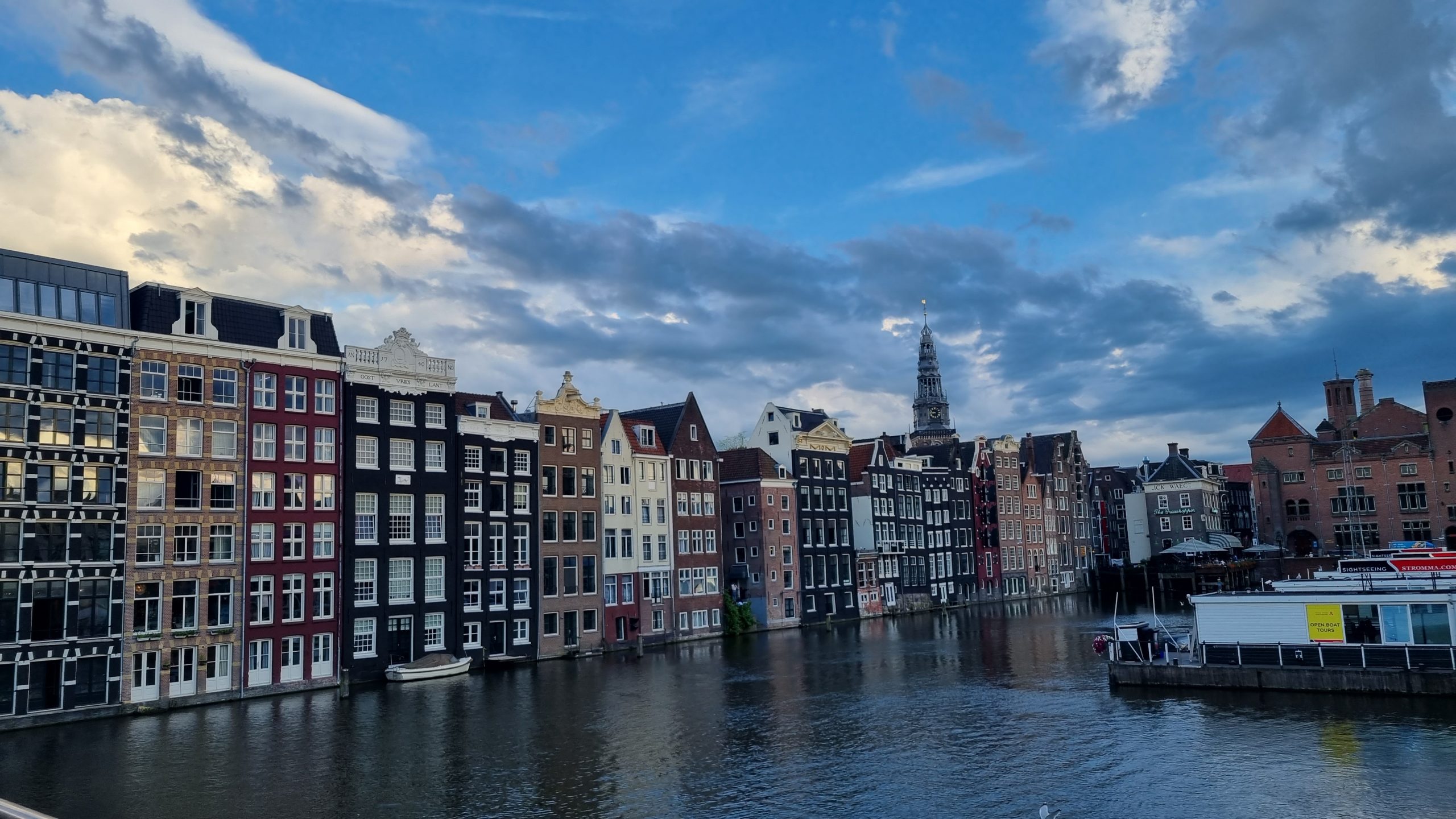
Amsterdam is one of Europe’s most charming and free cities. Don’t get confused by the network of canals and bicycle lanes: we’ve gathered together all the important tips on transportation, food, lodging, and communicating with locals to make your trip go smoothly. Also, read our guide on traveling to Amsterdam if you have not already.
Contents
Transport
Amsterdam = bicycles. Yes, it really is the most convenient transportation in the city in any season. Navigation is maximized, and every traffic light has a separate button to turn on the green light, which is specifically for cyclists. Having a car in the city is a luxury because of taxes and expensive maintenance.
If you decide to get a bike, be prepared to ride it responsibly. Raise your hand depending on which way you’re turning, so the cyclists behind you understand where you’re going. It’s really important for traffic.
You only realize the problems of Amsterdamers when you try to park your bike—all the spaces are usually full. Be patient and don’t strap your transportation in the wrong place—for example, to the bridge. There are multi-story free parking lots in the city that you can safely use (one of them is by Centraal Station). Be sure to check that your bike’s wheel is secured with a lock and the bike itself is buckled—they are very often stolen.
For everyone else, there are streetcars. They, like the trains, are very stable. Each stop has a scoreboard with the remaining waiting time. It never fails. Inside each streetcar, in addition to the driver, there is a conductor who will give directions, sell a ticket, or keep an interesting dialog going. Important: Only cards are accepted. Expensive, but you can make an infinite number of transfers and use not only streetcars but also metros and buses of the GBV company.
By the way, if the payment terminal on the streetcar doesn’t work and you don’t have a ticket, the ride is officially free.
Important: Bicycles are not allowed on streetcars and buses. You can take bicycles on the subway, but you have to buy an extra ticket and keep track of the time—you can’t take them during rush hour, otherwise passengers will be inconvenienced. But you can go down or up the subway in a comfortable and spacious elevator.
If you walk, don’t step on the bike lanes. Cyclists are the main people on the road. You have to let them pass and stay out of the way; otherwise, there’s a chance you could get hit. And, by the way, there’s a cool separate button at the traffic light for you to change to a green light, too.
Traveling to another city can be done by train. You can plot a route on the NS transportation company’s website so you know exactly what time and where the train leaves from, as well as how much the ticket costs. The country is quite small, so the journey will not take long.

Food
Coffee lovers rejoice. Almost everywhere it is brewed perfectly, and there are plenty of coffee shops (not to be confused with coffee shops).
Don’t forget to try the famous apple pie (appeltaart). The most famous place is Winkel 43.
On Sundays, you can find street markets (for example, Albert Cuypstraat in De Pijp) where you can buy not only clothes but also local street food, which is definitely worth trying. In small stalls, look for herring with onions, fries (frietjes), the famous waffles with hot syrup (stroopwafels), and small airy pancakes with powdered sugar (poffertjes).
The Dutch love to deep-fry everything. For example, for a budget snack, look for FEBO stores, a place with vending machines where you can buy all kinds of croquettes, as well as burgers, fries, and bitterballen meatballs.
In many cafés, menus are time-based: you can’t come at 2 p.m. and order soup if it’s in the “dinner” section. You have to wait until 6 p.m.
If you come to the café to work and take out a laptop, you are very likely to be moved to a common “work” table. On the plus side, there are bound to be plenty of outlets and nice people around.
Portions are often very large. You can order one dish for two and save money.
It is not necessary to tip the waiters—they are already included in the price of the bill.
Another way to eat on a budget is to go to the supermarket. Luckily, they are great in the Netherlands: lots of salads of all kinds, cut, and clean vegetables and fruits, assembled smoothie mixes—in general, everything for convenient living. You can make a salad at home in a couple of moments because they’ve already done all the work for you. Even chicken can be prepped and cut up in about five different spice options. Important: Have access to a translator with you because all products are labeled in Dutch. Food utensils, microwaves, and hot water can also be found in the store.
You can feel like a Dutch child by trying a traditional breakfast food—toast with butter and chocolate sprinkles (hagelslag). You can find this dish in some cafés, or you can make it yourself; you can buy the sprinkles in the supermarket. You’d be surprised how many types of hagelslag there are.

Accommodation
It is very expensive to live in Amsterdam. A bed in a hostel costs about €40–50 per night. Apartments start at €110 per night; closer to the center, they become more expensive. It’s best to stay a little further away from Amsterdam—it’s quieter and cheaper. You can get to the city fairly quickly by the same means: bicycle, streetcar, and train.
The stairs in the houses are sloped at a very large angle. Be careful, especially at night.
When you leave the apartment, the door does not need to be closed with a key—it closes by itself.
Don’t forget to sort your garbage! If you don’t live in the center, look for underground bins near your house; there are four of them: paper and cardboard, plastic, glass, and non-recyclable garbage. There is also an underground textile recycling bin if you look for it.

Other stuff
Before you go to any store, café, or museum, study their opening hours. Popular non-working days: Sunday, Monday, and Tuesday.
Check carefully what payment methods are available where you’re going. Because of the additional tax on international Visa and Mastercard cards, many places only accept cash and Maestro cards from local banks. There are also places that don’t accept cash at all. It’s best to ask the cashier or waiter in advance so you don’t get into trouble.
English is almost as important here as the local language, Dutch. In schools, they start teaching it at the age of 4, so everyone speaks it very fluently. There will definitely be no problems with communication.
Although the Netherlands is a very free country, respect the signs in the city center. Not everywhere you can drink alcohol and smoke.
If you need help, feel free to go to the police officers. They are kind, polite, and ready to answer all questions.
Don’t be frightened by the straightforwardness of the Dutch; it is their special trait.
Take a reusable water bottle with you on your walk. There are water fountains in the park, and you can also ask a café to fill them for you. It’s free if you ask nicely.
In April and October, in the heart of the city, Dam Square, you can ride rides, taste local sweets, and just have a great time.
Dress warmly; the weather is very changeable.
Prebook museums that you want to visit; otherwise, with the highest level of probability, you couldn’t catch a slot.
Also, In Amsterdam, you can visit some museums for free. For example, in the free Cheese Museum, in addition to an interesting tour, tourists are often offered a tasting of Dutch specialties. Free one-hour guided tours are organized at the oldest Dutch diamond factory, “Gassan.” Here, you’ll be told about the diamond industry and shown different beautiful stones. But the most interesting thing is the opportunity to visit the workshop and learn some subtleties of the art of working with stones yourself. Just don’t forget to register for the tour in advance.

Written by:


 Yuliya Yanukovich
 Artur Gurin